We’re in the middle of a little glow-up. Some links may not be available just yet, but we’re working behind the scenes to bring everything to life. Thank you for being here while we build something beautiful for you.



How to Create a Bedtime Routine Your Kids Will Actually Follow (Without the Nightly Meltdown)
When Bedtime Feels Like the Hardest Part of the Day
It's 7:45 PM. You've already made dinner, cleaned up dinner, refereed two arguments about whose turn it is to pick the show, and said the words 'go brush your teeth' no fewer than six times.
You are done. But your kids? They are somehow operating at full capacity, completely unaware that you have been running on empty since approximately 2 PM.
If this sounds like your evening, I want to say something to you before we get into any tips or strategies: you are not doing it wrong.
Bedtime resistance is one of the most common struggles parents face with children aged 3 to 8, and it almost never has anything to do with bad parenting. It has everything to do with the fact that young children lack the neurological tools to downshift from the stimulation of a busy day into a calm, sleep-ready state — unless someone teaches them how.
The good news is that a consistent bedtime routine changes everything. Not overnight. Not magically. But with repetition and the right structure, your evenings can go from a nightly negotiation to something that actually feels good for both of you.
In this post, I'm going to walk you through exactly how to build that routine — one that works with your child's brain, not against it.
Why Routines Work (And Why Winging It Doesn't)

Before we build anything, let's talk about why this matters scientifically, not just logistically.
Young children's brains are still developing their ability to regulate emotion and manage transitions. When the structure of their day is unpredictable, their nervous system stays on alert — because it doesn't know what's coming next.
But when the same sequence of events happens in the same order every night, the brain starts to recognize a pattern.
That recognition triggers a biological response: the body begins producing melatonin earlier, cortisol levels drop, and the child naturally starts winding down before they even get into bed.
In other words, a good bedtime routine doesn't just tell your child it's time to sleep. It trains their body to feel sleepy at that time.
This is the difference between a routine and a schedule. A schedule is a list of times. A routine is a series of cues that the brain and body respond to automatically, over time, with consistency.
Research from the American Academy of Sleep Medicine consistently shows that children who follow a consistent bedtime routine fall asleep faster, wake less frequently at night, and get more total sleep than children without one.
And when kids sleep better, they behave better, learn better, and regulate their emotions more effectively during the day. The routine is doing a lot more than getting your kid to bed.
The 5 Elements Every Effective Bedtime Routine Needs

Not all routines are created equal. Here's what the research — and experience with hundreds of families — suggests needs to be in place for a routine to actually work.
1. A Clear and Consistent Start Time
The routine needs to start at roughly the same time every night, even on weekends. Not to the minute — within 30 minutes is fine. But if bedtime starts at 7 PM on school nights and 10 PM on weekends, your child's circadian rhythm will never fully sync up.
Pick a start time that works for your family and commit to it. For most kids aged 3 to 8, a start time between 6:30 and 7:30 PM works well, with lights out between 7:30 and 8:30 PM.
2. A Transition Signal From 'Day' to 'Evening'
Kids need a clear cue that the active part of the day is over. This could be dimming the lights after dinner, turning off the TV, doing a five-minute tidy, or even just changing into pajamas.
The specific activity matters less than the consistency. Whatever signal you choose, use it every single night so the brain starts associating it with 'winding down.'
3. Physical Calming Activities
Before bed, the body needs to shift gears physically, not just mentally. A warm bath or shower is one of the most effective tools available — the rise and fall in body temperature that happens afterward mimics the temperature drop that naturally precedes sleep.
Other helpful activities include gentle stretching, a slow walk around the house, or even just sitting quietly together for a few minutes.
4. A Reading or Story Time
Reading aloud to children before bed has an almost miraculous effect on their nervous system. It slows the breath, reduces heart rate, and gives the mind something gentle to focus on that isn't a screen.
This is also why story-based tools are so powerful — they combine the calming effect of a story with specific techniques that help children self-soothe.
The storybooks inside our Complete Peaceful Bedtime Toolkit address exactly this — each story teaches your child a different self-soothing skill through a character they'll love.
5. A Predictable Goodbye Ritual
The hardest moment of bedtime for many children is the transition from being with you to being alone. Having a short, predictable goodbye ritual — the same hug, the same words, in the same order — helps children feel secure enough to let go. Keep it warm, keep it brief, and keep it the same.
Building Your Family's Routine: A Step-by-Step Guide
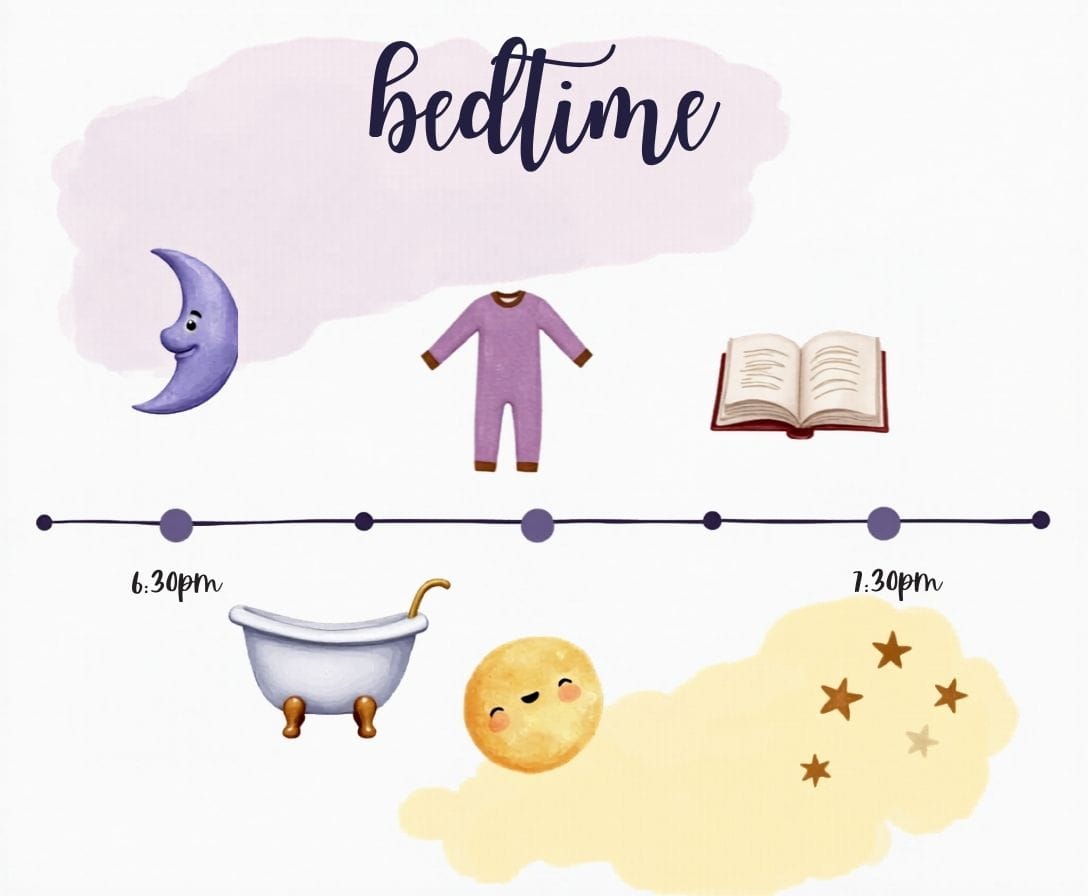
Step 1 — The Wind-Down Signal (5 minutes)
Choose your transition cue and use it consistently. Our family dims the lights throughout the house and turns off all screens at the same time every night. Some families use a specific song, a gentle chime, or simply announce 'okay, wind-down time' in a calm voice.
Whatever you choose, the goal is to create a Pavlovian response: the cue happens, and the child's brain begins preparing for sleep.
What to avoid: Don't try to go straight from full activity directly to bed. The brain needs a ramp-down period, not a cliff. Give your child at least 20 to 30 minutes of increasingly calm activity before you expect them to sleep.
Step 2 — Bath or Hygiene Time (10-15 minutes)
For younger children, a warm bath is one of the most effective pre-sleep tools you have. The warm water relaxes muscles, and the subsequent cooling of the body triggers the sleep drive. Make this time pleasant and low-stakes.
Keep the lights slightly dimmer than usual if possible. Talk quietly about the day — not a time for problem-solving or disciplining, just a gentle connection.
Step 3 — Pajamas and Comfort Prep (5 minutes)
Getting into pajamas is a surprisingly powerful cue for the body. Comfortable, breathable sleep clothes help signal the shift from day to rest.
This is also a good time to check in on your child's comfort level with the room: temperature, nightlight, and white noise if they use it.
Step 4 — The Calm-Down Activity (5-10 minutes)
Before story time, give your child two to three minutes of a quiet, non-stimulating activity: coloring a single page, doing a gentle breathing exercise together, or looking at a picture book alone.
This is the buffer between the busyness of the day and the stillness of story time — it prepares their mind and body to actually absorb and enjoy the story rather than wiggle through it.
Step 5 — Story or Reading Time (10-15 minutes)
This is the heart of the routine for most families. Read together for at least 10 minutes. For younger children, choose gentle picture books with calm endings. For older children, a chapter from a longer book works beautifully.
If your child struggles with specific bedtime fears or patterns, our peaceful bedtime routine guide walks through story-based solutions for each specific challenge, with five storybooks each designed for a different bedtime pattern.
Step 6 — The Goodbye Ritual (2-3 minutes)
Keep this simple and identical every night. In our family, there are three things we do: one hug, one kiss, 'I love you, sweet dreams, I'll see you in the morning.' That's it. No variations. No negotiating for more. The consistency of this goodbye is what makes it feel safe.
When the Routine Breaks Down: Troubleshooting Common Problems

'My child keeps getting out of bed.'
This usually comes down to one of two things: the child isn't tired enough yet (try pushing bedtime 15-20 minutes later), or the child is anxious about being alone, and the goodbye ritual isn't providing enough security.
One 'free pass' card per night — exchangeable for one additional need — removes the endless negotiating because the child feels they have agency.
'My child is scared of the dark or shadows.'
Darkness anxiety is extremely common in children aged 3 to 7 and is completely developmentally normal.
A small nightlight, a 'monster spray' bottle (just water with a fun label), or a flashlight they can keep by their bed are all simple tools.
Don't dismiss the fear — validate it and give your child tools to manage it.
'My child stalls endlessly.'
The more predictable the goodbye ritual, the less a child feels compelled to delay it. Try the free pass system: a small card exchangeable for one additional need after lights out. Once it's gone, it's gone.
A Note on Patience and Repetition
If you implement this routine tomorrow night, it probably won't work perfectly. That's not failure — that's how habit formation works.
Your child's brain needs to encounter the same sequence repeatedly before it starts responding automatically.
Most families see meaningful improvement within two to three weeks of consistent implementation.
The Parent's Guide inside the Complete Peaceful Bedtime Toolkit walks through exactly how to stay consistent during that adjustment period — including what to do when your child pushes back and how to handle regressions.
Your Bedtime Routine Template
6:30 PM — Wind-down signal (screens off, lights dim)
6:45 PM — Bath or hygiene time /Pajamas + comfort check
7:00 PM — Quiet calm-down activity
7:15 PM — Story time together
7:25 PM — Goodbye ritual
7:30 PM — Lights out
Adjust the times to fit your schedule. The sequence is what matters more than the clock.
🖨️ Want This as a Ready-to-Print Chart?
I turned this routine into a beautiful one-page printable your child can follow independently — complete with icons for each step, a checkbox they tick off themselves, and a little star reward at the bottom.
Kids who can see their routine become more cooperative almost immediately.
"This bedtime routine template is the structure. If you want the tools that bring each step to life — the stories, the charts, the scripts — that's exactly what the Toolkit is built for."
Get the Complete Peaceful Bedtime Toolkit → Use code EARLYBIRD20 for 47% off.
About the Author/s:
Mia Moon
Child Development & Family Routines Creator
Mia is the founder of SamCreates, a resource hub for families building calmer daily routines. Grounded in child development and emotional regulation research, she creates stories and printable tools that help young children navigate big transitions — including bedtime — with more ease and less stress. Her work is rooted in a simple belief: small, intentional systems can completely shift the emotional energy of a home.
Toni Parkers
Mom of Three · Co-Creator & Contributing Writer
Toni is a mom of three who knows firsthand what it's like to dread 8 o'clock. After years of drawn-out routines, endless requests for water, and little ones who simply refused to stay in bed, she made it her mission to find what actually works - not just in theory, but in a real, busy household. Her real-life experience and trial-and-error wisdom shape the heart of every tool and story inside SamCreates - bringing honesty, warmth, and real-mom perspective to everything we create together.





Helping Busy Moms Create Peaceful Evenings and Calmer Homes
Because peaceful homes don’t happen by accident. They’re built through thoughtful structure and gentle routines.
Featured Product

The Complete Peaceful Bedtime Toolkit
Create calm, cozy evenings with your kids
DISCOUNT CODE: EARLYBIRD20
(First 50 Buyers Only)
Copyright Notice
© 2025 SamCreates. All Rights Reserved.
Created with systeme.io